An analyst, not a dashboard
A personal agent that shares the same world model as the newsroom — with persistent memory of your context, your decisions, and your bets. Create your account and set up your personal Brújula in five minutes.
Every source on the map, connected to your decision
fed by 40+ active sources · filtered to your context · See current model state →
Your projects, not a template
Every week your letter includes a dedicated section for each of your active projects. It's not a generic paragraph "adapted to your profile"; it's specific analysis of your mission, your vision, your context — written by the same model tracking 8 master theses and 39 granular ones on the map.
You can keep up to 5 active projects: a fund you manage, a company you're building, a personal decision in play, a hypothesis you want to test. Every week Brújula tells you which movements in the world touch each one — and which don't, with the same honesty.
Projects are set up from your dashboard after creating your account.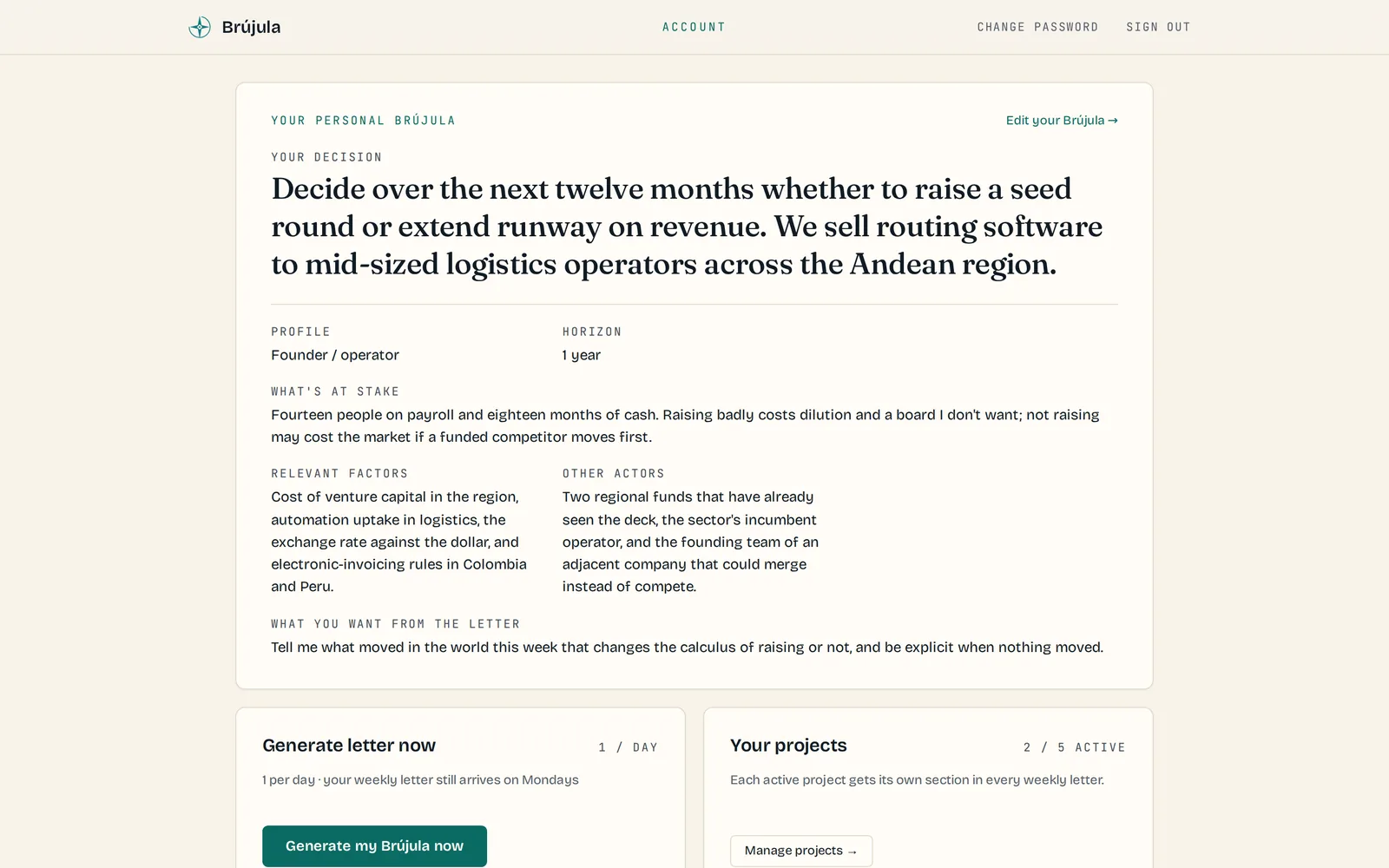
Three modes, one model
The agent works on the same thesis-and-probability structure you see in public — but applies it to your situation.
Diagnostic
Where you stand vs the model. The agent maps your context against active theses and tells you which forces affect you and by how much.
Exploratory
What if. Walk through alternative scenarios on the same probabilities, without leaving the audit trail to sources.
Generative
What you'd do about it. Proposes moves and puts them through defensive and constructive stress tests — always as an instrument, never a recommendation.
Your situation, updated as the world moves
Not a chat log. A living record of your context that the agent revisits every time the model moves. When a thesis that affects you changes, you'll know — with the anchor, the magnitude, and the date.
This feature is in development. We'd rather say so than show you a mock-up of it. What the dashboard already gives you today is above and below: your Brújula profile, projects, on-demand letter generation, chat, and letter history.
Personal access
Compass
BETA · AVAILABLE NOWInstitutional
IN DEVELOPMENTNot a mock-up. The real thing.
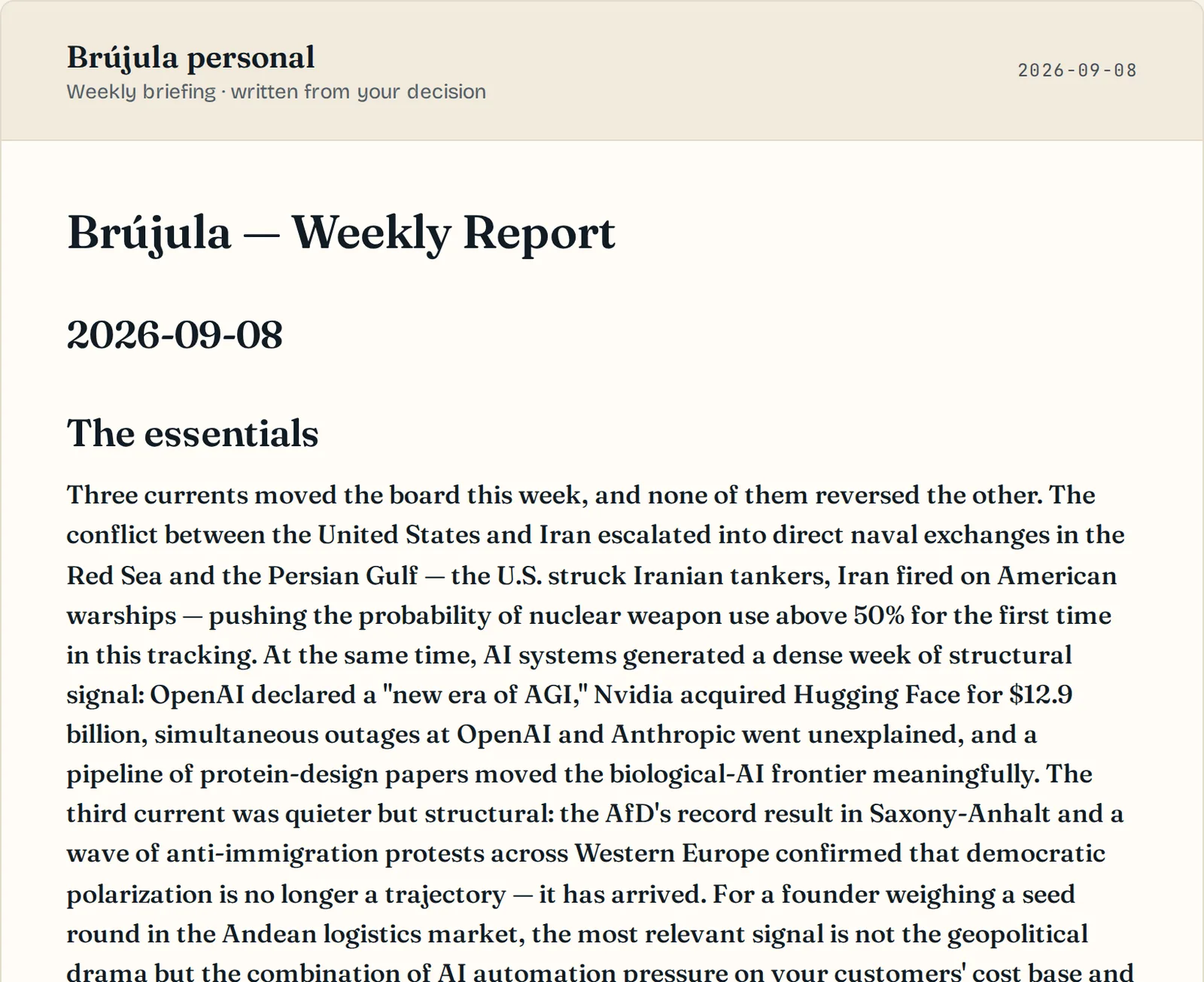
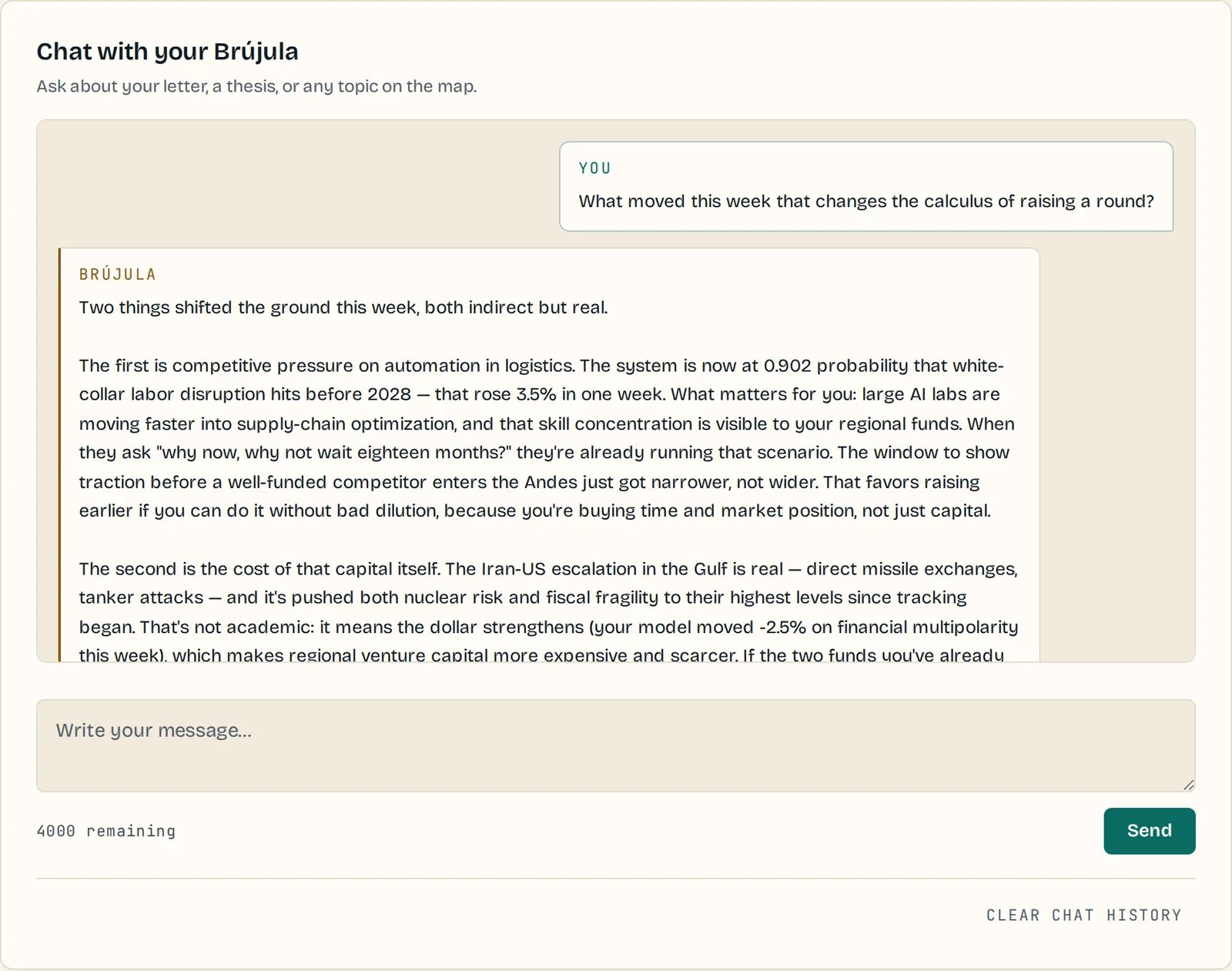
These are screenshots of the running product, taken from a demonstration account whose profile and projects are invented for this purpose. The letter and the answer you see below were written by the same model that writes yours — nothing here is staged.
Five minutes and your personal Brújula starts.
One decision. One letter every Monday. The same model the newsroom runs on.